

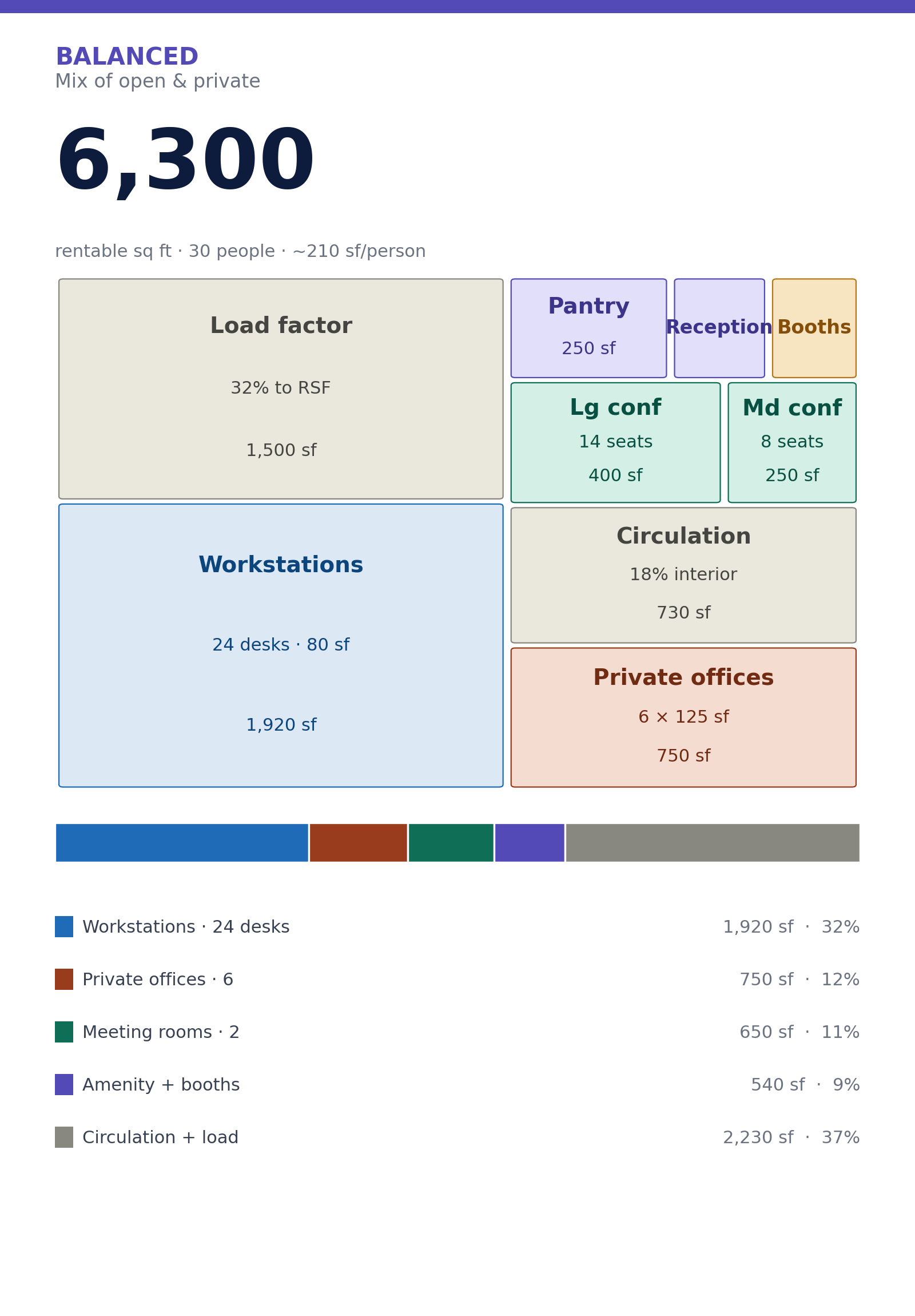
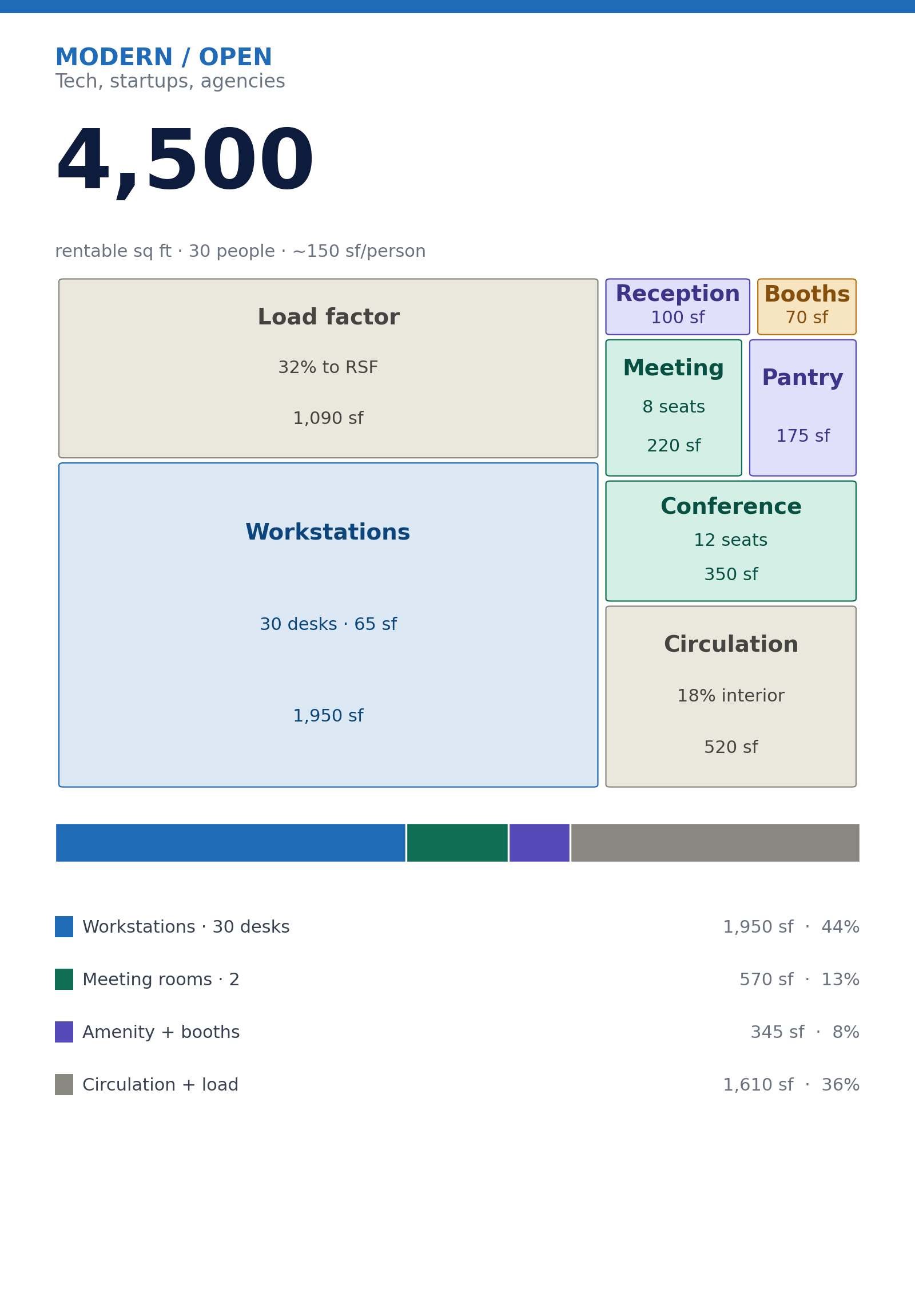
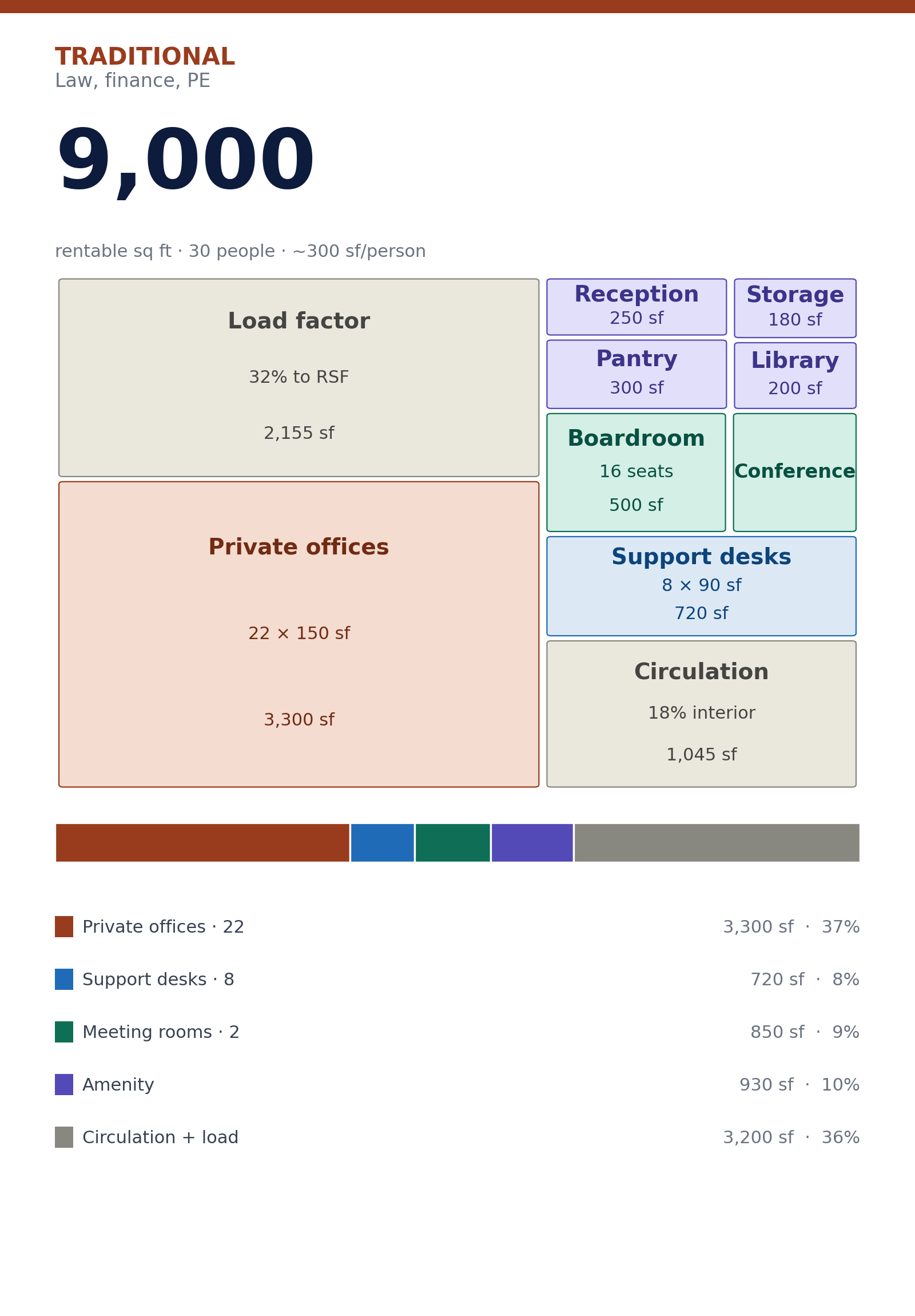
A 25-person tech company on the open-plan end of the spectrum might be looking at 3,100 – 3,750 RSF. A 25-person law firm at the traditional end might need 6,250 – 8,125 RSF. Same headcount, more than double the space.
Two things to flag immediately. First, these are rentable square feet — the number that actually goes on your lease — not usable square feet. In NYC, rentable typically runs 25-30% larger than usable because of the building load factor (we’ll get to that). Second, the ranges above assume everyone is in the office full-time. If your team is hybrid, the math changes meaningfully.
Why Per-Person Averages Break Down
Per-person benchmarks are useful for a first-pass estimate. They fall apart when you try to apply them to a specific team. Three variables explain most of the variance:
Hybrid attendance. If your 30-person team comes in 3 days a week, you don’t need 30 workstations — but you don’t need 18 either (30 × 60%). Hybrid attendance clusters. Everyone shows up on Tuesday, Wednesday, and Thursday. Monday and Friday are sparse. If you desk-share based on average attendance, you hit capacity crises mid-week. Most firms end up at roughly 70-80% of full headcount in seats, which lands between the naïve hybrid math and the full-attendance estimate.
Room count. A firm that needs two large conference rooms, five private offices, and eight phone booths is starting with ~1,500 square feet of fixed rooms before we even talk about workstations. A firm with a single huddle room and open benches has almost none of that overhead. This is the single biggest differentiator between law firm layouts and tech layouts.
Amenity expectations. The NYC office market has shifted. Tenants now expect a proper pantry or café, a reception area, sometimes a wellness room or mother’s room, often a lounge or breakout space. Ten years ago, a 5,000 SF office had maybe 400 SF of common space. Today, it’s closer to 800-1,000 SF. That’s real square footage you’re paying for, and it’s worth budgeting accurately.
What the Calculator Actually Does
The calculator takes the per-person approach and layers in those three variables. Here’s the logic: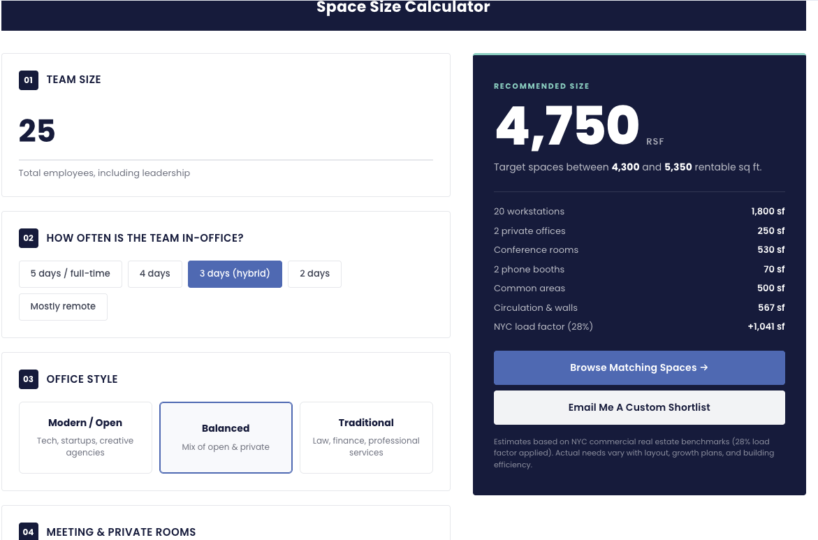
- 1. It takes your headcount and multiplies by your work-style ratio (1.0 for full-time, down to 0.35 for mostly remote). A 10% buffer on top handles growth, guests, and peak attendance.
- 2. It multiplies that workstation count by a per-desk density — 65 SF for modern/open, 90 SF for balanced, 120 SF for traditional. These figures account for the desk, chair, circulation around the desk, and allocated share of aisle space.
- 3. It adds your specified offices (125 SF each), small conference rooms (180 SF), large conference rooms (350 SF), and phone booths (35 SF).
- 4. It adds your common areas — reception, pantry, lounge, etc.
- 5. It applies 18% for interior circulation (hallways, walls, columns inside the space).
- 6. Finally, it applies a 28% load factor to convert from usable to rentable square feet — the number you’ll actually lease.
The output is a single recommendation with a high-low range (typically ±10%), because even the best benchmarks have tolerance.
The Factors Every Tenant Underestimates
A few specific items come up repeatedly in conversations, and tenants consistently get them wrong.
Hybrid attendance math
The temptation with a hybrid workforce is to size for an average day. I strongly recommend sizing for a typical peak day instead. If Tuesday-Thursday regularly sees 75% attendance, you need seats for 75% — not for the Monday-Friday average of 55%. The alternative is a team that fights over desks three days a week, which kills morale faster than a tight office.
Phone booths
Open-plan offices without enough phone booths are noise nightmares. A good rule: one private phone booth per 10-12 open-plan employees. Most tenants plan one or two for a 30-person team and regret it within a quarter.
Conference room count
Most professional-services firms need more conference rooms than they think. A 40-person law firm typically uses 3-4 meeting rooms simultaneously during peak hours. Plan for that, not for the one big boardroom that looks good on the floor plan.
The pantry
The pantry is the highest-ROI square footage in a modern NYC office. It’s where people gather, where informal conversation happens, where new hires meet coworkers. Skimping here is the single most common mistake I see in first office fit-outs. Budget 250-350 SF even for small teams.
The load factor
NYC buildings are measured aggressively. A 5,000 usable-square-foot space will typically lease as about 6,400 rentable square feet — a 28% load factor is standard in most Class A buildings, and some prestige towers push past 35%. If you come from a Sun Belt market where load factors run 12-15%, this shocks you at lease signing. Budget for it upfront.
Neighborhoods and What They Cost
Space sizing and neighborhood selection are linked. Larger floor plates in newer buildings (think Hudson Yards or One Vanderbilt) give you more efficient layouts per rentable foot. Older loft buildings in Flatiron or SoHo have more charm but typically worse efficiency and steeper circulation costs.
Rough current ranges for Class A and trophy space:
- Hudson Yards: $110-150 PSF for trophy towers, $85-110 for newer-construction alternatives. Efficient floor plates, modern infrastructure, amenity-rich buildings.
- Plaza District: $120-180 PSF for premier buildings on Park/Madison between 50th and 59th. The long-standing home of hedge funds and private equity.
- Flatiron: $75-110 PSF for creative loft and Class A alternatives. Strong for tech, media, and agencies.
- Financial District: $55-85 PSF for renovated Class A. Best value per square foot in Manhattan if talent commute patterns work.
- SoHo / Hudson Square: $85-115 PSF for creative space, often loft conversions with character.
These aren’t quotes — they’re ranges. Actual rent depends on building, floor, concession package, term length, and the timing of your deal.
What Changes When You Actually Tour Space
One more thing worth knowing: the calculator output gives you a target range. What the target range does not account for is how a specific building’s layout affects efficiency. A 6,000 RSF space with a wall of windows on one side and a deep, narrow floor plate uses space differently than a 6,000 RSF space on a more square floor with windows on two sides. The same tenant fits into one and not the other.
This is where a broker earns their fee. When you tour, we walk the space with your requirements in hand and tell you whether it actually works — not just whether it hits the square footage target. Two spaces at 5,800 RSF can be functionally different in terms of how many workstations, offices, and rooms they support.
If you use the calculator and want a broker’s-eye read on what actually fits, reach out. We’ll tour with specific requirements in mind and send you short-listed options — including off-market space you won’t find on search engines.
A Few Common Mistakes Worth Avoiding
Over years of representing tenants, a handful of errors repeat:
- Leasing for peak attendance on day one, with no buffer for growth. If you’re growing 15-20% annually, you’ll be back in the market in 18 months. Build in room.
- Over-indexing on one metric. A space can hit your workstation count and still fail because the conference rooms are wrong size or the pantry doesn’t work.
- Believing the square footage number on the listing without verification. Confirm rentable square footage in writing. Landlords occasionally round generously.
- Skipping a test fit. For any lease of 5,000+ SF, ask the landlord’s architect to do a test fit showing your team in the space before you sign. It costs nothing to the tenant and catches problems that aren’t visible from a tour.
- Not understanding the TI allowance math. Your tenant improvement allowance is often structured per rentable square foot. Larger spaces = more TI dollars, which can offset the base rent difference on a well-negotiated deal.
The Bottom Line
Most NYC tenants can size their office to within 10% accuracy using a decent calculator and 30 seconds of honest self-assessment. The remaining 10% — and the difference between a great deal and an average one — comes from on-the-ground knowledge of buildings, landlords, and deal structures.
Start with the calculator. Get your target range. Then if you’d like a broker’s-eye view on buildings that fit your profile, we’re here.